
CC BY 4.0 (除特别声明或转载文章外)
如果这篇博客帮助到你,可以请我喝一杯咖啡~
Node Embeddings
start=>start: Input Graph
info=>operation: Structured Features
setCache=>operation: Learning Algorithm
end=>end: Prediction
start->info->setCache->end
Input Graph –> feature enginearing now we abrod that Automatically learn
Graph Representation Learning
Goal: Efficient task -independent feature learning for machine learning with graphs
Why Embedding
Task:map nodes into an embedding space
Setup

Shallow Encoding encoder is just an embedding-lookup
Framework Summary
Encoder + Decoder Framework - Shallow encoder:embedding looup - Parameters to optimize: Z which contains node embeddings zu for all nodes u <V
- Decoder : based on node similarity
- Objective: maximize ZvT Zu for node pairs(u,v) that are similar
Random walk Approaches for Node Embeddings
- Vector Zu:
-
Probability P(v Zu): - softmax
- sigmoid
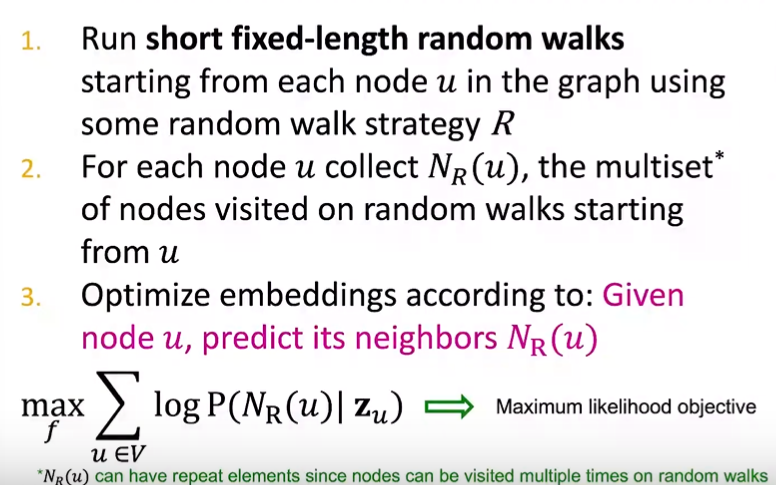
Random Walk Embeddings

Unsupervised Feature Learning
Intuition:
- Find embeddding of nodes in d-dimensional space that preserves similarity idea:
- Learn node embedding such that nearby nodes are close together in the network Given a node u , how do we define nearby nodes?
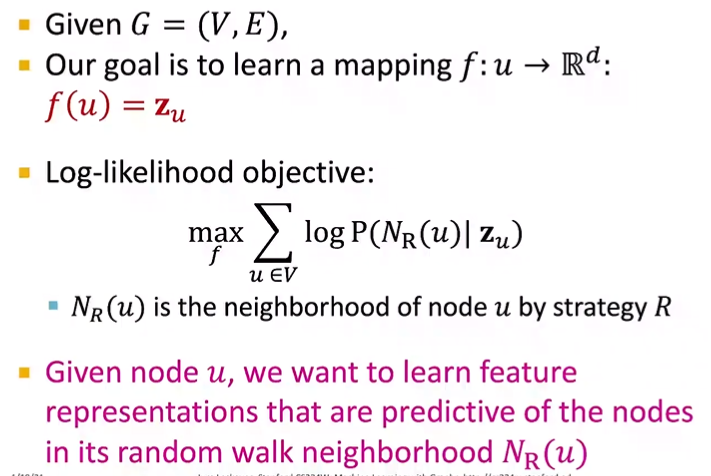
Feature Learning as Optimization
Random Walk Optimization
Overview of node2vec
Goal: Embed node with similar network neighborhoods close in the feature space Key observation: Flexible notion of network neighborhood Nr of node u leads to rich node embeddings.
Embedding Entire Graph
Summary
3 ideas to graph embeddings Approach1: embed nodes and sum/avg them Approcah2: Create super-node that spans the (sub) graph and then embed that node Approach3: Annoymous Walk embeddings Idea1: sample the anon. Idea2: Embed annoymous walks
How to use embeddings zi of nodes:
- Clustering / community detection
- Node classification
- Link prediction
- Graph classification